Showing posts with label Social Psychology. Show all posts

Thursday, 22 April 2010

Crave Creativity? Live abroad.

We all know what a liberating experience being in a foreign country can be. Apparently it can also be a potent creative trigger. There are plenty of artists/thinkers who jump to my mind as brilliant examples of this postulate. Munch's Frieze of Life was conceptualised and executed while he was in Berlin. Nietzsche wandered through Genoa, Nice, St. Moritz and Turin between 1879-1889, writing Daybreak, portions of The Gay Science amongst other writings. Samuel Beckett spent many of his writing years away from Ireland - in London & Germany. Kafka's on and off love affair with Bavaria....the list goes on.

What is it about a foreign land that acts as a Muse?
Research cited in a prominent Social Psychology journal may have an answer. William Maddux (INSEAD) and Adam Galinsky (Northwestern) conducted 5 different studies using a variety of methods to establish a link between time spent living abroad (this explicitly excludes time just travelling abroad) and creativity. The authors start by giving a succinct overview of the personality and contextual variables associated with creativity. These alone make for quite an interesting reading and would be a handy starting point for anyone wishing to explore this area of research. Meta-analytical studies have reported creative persons possessing above-average intelligence, tolerance of ambiguous information, higher levels of energy, self-confidence, intrinsic motivation, ambition, open attitude towards risk and cognitive flexibility (MacKinnon, 1978). It should be pointed out though that the ‘profile’ of a creative person varies with the Industry or professional domain. Creative artists are very different to creative scientists, for example.
The chief components of the authors’ hypothesis explain the rationale behind this study:
  • Firstly, (and understandably) living abroad allows people access to a larger number of novel ideas and concepts, which is believed to act as precursors for a creative exercise.
  • Secondly, the authors postulate that living abroad gives people access to different perspectives of approaching problems.
  • Finally, experiences in alien cultures are indicators of ‘psychological openness’ to novel ideas and result in a marvellous cognitive expansion of the subject’s creative repertoire.

The researchers used a number of different studies to investigate their hypothesis. These included the famous Duncker candle problem (you can read about it here), a task measuring creative one-to-one negotiation skills, a test of convergent thinking (where word association was used), and a creative generation task that requires the participants to draw an alien creature (where you imagine stumbling onto a very different Planet in a Galaxy far, far away and encounter an alien). The results indicated a consistent and robust link between the creativity measures employed and the time that subjects had spent living abroad. Although, I am personally not too convinced by the usage of the Duncker problem as it has been so widely used in undergraduate Psychology classes as well as in ice-breaker sessions across the business world that it hardly comes across as a valid measure of creativity.

The most powerful construct that the authors do explain in this study as being the mechanism beneath the creativity-living abroad link is adaptation. They say, “Because culture is such a pervasive force, impacting and shaping every aspect of one’s life, adapting oneself to a new culture—learning how to behave and think in different way—may make individuals chronically aware of multiple perspectives and approaches when dealing with mundane and novel situations and, thus, may be associated with increased creativity.”

In view of the above, the diversity intention behind those equal opportunity questionnaires makes solid business sense. I think the Corporate world is already onto this. Perhaps it’s time for the recruitment consultants to reformat candidate CVs in terms of Countries visited and lived in! Whether or not the Duncker Candle task makes it to the assessment centres is of course another issue.


References:
Maddux, W, Galinsky, A, Cultural Borders and Mental Barriers: The Relationship Between Living Abroad and Creativity (2009), Journal of Personality and Social Psychology, 96, 1047–1061. http://psycnet.apa.org/?fa=main.doiLanding&doi=10.1037/a0014861

Sunday, 28 March 2010

Craving the Sound of Silence


Where
did all the silence go?
I sit on a bus/train and 66% of the people are on their phones, oblivious to the unwelcome intrusion they exercise by belting out details of their mundane lives on top of the stoppage announcements in the vehicle. I don't want to know about your latest crush in school. I also don't need to know what was so shocking in your friend's day that made your entire conversation a recurring series of "No!" and "Really?" and an occasional "Wow!".
I don't understand why everyone doesn't have their phones on vibrate? Making a personal statement via your ring tone? What a depressing death of all known modes of creativity.
My tolerance is also abysmal for the leaky standard iPod earphones.

Psychiatrically speaking though, I wonder if there is something seriously dysfunctional about a world where people cannot wait to actually get home to have a decent conversation with the spouse. They have to get it out of the way while being Publicly transported. I know I am making a prejudiced differentiation between a phone conversation and sitting down with a book. When you think about it, they are not that different. Except for the intrusion aspect, I guess. Rare would be that annoyance that comes off a nicely creased spine, yellowed cover pages of a Penguin Classic. I am prejudiced.

Where did all the Marketing sense go?
A popular consumer opinion website recently ran a survey asking users to comment on which advertisements were annoying them the most. Not surprisingly, with a resounding majority (more than 7000 votes!) the obnoxious winner is everyone's most hated moustached man on Go Compare.


Perhaps, being annoying and loud = memorable = better product recall = effective advertising? Unfortunately not. Amongst the hundreds of blog posts, comments, websites dedicated exclusively to shred any claims of the advertising merit of this promotion, there is no indication whatsoever of any likelihood of using the product based on this campaign.

Let's bring Psychology in
In fact research by Douglas, Kellaris, Cox and Cox and several others suggests that advertisements without music performed better on recall and recognition measures than ads with music.
Therefore even though I wonder if this loud and pointless Promo may perhaps result in the downfall of the product in question, I'd be maligning the scientific method, if I were to say that the usage of the product has or may have suffered due to this marketing fiasco. I would need empirical evidence for that particular website usage over the past few months in order to say that.

Let's check some figures: Market share as on Dec 2009 compared to Dec 2008

1. Moneysupermarket.com 18.97 per cent (-4.3 per cent),
2. GoCompare.com 6.89 per cent (+0.72 per cent),
3. Confused.com 4.23 per cent (+0.5 per cent),
4. Comparethemarket.com 3.32 per cent (+1.93 per cent)

It appears that biggest rising star is the friendly Russian Meerkat.


Crushingly though, GoCompare has also registered a recent increase!
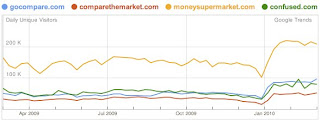
Check the Google Trends report for usage of some websites.


I'll post in another 2 months with more data to corroborate my tentative hypothesis. Right now the rising trend is too small for me to discard my hypothesis and the advertisement is too awful for me to give up moaning about it.


References:

1. Market share data from business.scotsman.com.
http://business.scotsman.com/medialeisure/-Terry-Murden-looks-at.5988705.jp
2. Trends data from Google
3. Douglas, Olsen G, Creating the contrast: the influence of silence and background music on recall and attribute importance. Journal of Advertising (2005)

Wednesday, 17 March 2010

Hazards of Obedience

So, yet another bunch of pop Psychologists, this time in the guise of a panel responsible for a fake French Game Show have attempted to replicate Stanley Milgram's classic albeit controversial experiment conducted at Yale University in the 60s.


The original Milgram experiments investigating obedience to authority used a simple experimental design and placed one of two subjects in the role of a "teacher" and the other was the designated 'Student'. The subjects were informed that the experiment is on memory and learning and on the effects of punishment on these. The 'student' is then put in another room strapped to a chair and explained that he needs to learn word pairs. E.g. When initially presented with 'Butter - Bread' he needs to be able to respond with Bread when the 'Teacher' presents the cue Butter. If he failed to recall the correct second portion of the presented word-pair, he would be administered an electric shock. What is noteworthy is that the 'Student' is actually an actor and receives no real shocks. The subject in the role of the teacher however, does not know this and is expected to operate a panel delivering shocks of varying intensities going right up until a fatal Voltage on the insistence of the experimenter whenever the student is wrong.


How far is too far?
Surprisingly (contrary to the consensus that Milgram himself obtained from a range of individuals including Psychiatrists, general educational community etc.) more than 60% of the subjects were willing to go to the absolute limit of the shock spectrum administering almost 450 Volts at times to the 'students'. This was despite the full realisation of the discomfort being voiced by the actors in the other room who in some cases pleaded to be set free and demanded to be released from the experiment.
What is interesting to note is that while a few subjects refused to carry on, a majority were quite compliant to the demands of the experimenter and pulsed lethal dosages of electric current to strangers! The moral compass, it seemed, collapsed when faced with an authoritative figure. This platform is inadequate for discussing the ethical, moral and legal ramifications of this experiment. Needless to say, the French TV show has brought these issues in the forefront again. Another quite similar offspring of this fascination of Media with Psychology was the Oliver Hirschbiegel movie Das Experiment (German, 2001) which tackled issues of authority and role playing gone wrong.


Milgram experiments of the 21st Century
Try approaching a Grant awarding body with a proposal of replicating Milgram experiments! Understandably the entire issue is laden with too valid an argument against carrying out experiments that knowingly put people in extremely distressing situations and are designed on deception. However, compliance, obedience, authority and personality characteristics that make some people more vulnerable to these than others is a valuable field of research and it would be a shame not to explore it further.
In comes immersive virtual reality.
Slater et al (2006) carried out the original Milgram experiments but replaced the 'students' with a virtual female human being on a computer. The cyber victim protested with genuine discomfort and demands for experiment termination as the original Milgram actors. The researchers concluded that "in spite of the fact that all participants knew for sure that neither the stranger nor the shocks were real, the participants who saw and heard her tended to respond to the situation at the subjective, behavioural and physiological levels as if it were real."


Read More

1. Milgram S. Obedience to Authority: McGraw-Hill; 1974
2. Slater M., Antley A., Davison A., Swapp D., Guger C., Barker C., Pistrang N., Sanchez-Vives M. V. (2006. ). A virtual reprise of the Stanley Milgram obedience experiments. PLoS ONE 1, e39.

Saturday, 27 February 2010

Nervous Cockroaches

One of the most striking Research Studies that I encountered in my Undergraduate Social Psychology year was the work by Robert Zajonc. It, like most seminal works in Psychological Research elicits the response "Oh, I could've told you that!" or "That's just common sense!"

So what did the guy do? Rather, who did he do it on?


72 lovely cockroaches were recruited to run on a race track of sorts (easy) as well as in a maze (difficult).

Another variable introduced into the proceedings was the presence or absence of an eager audience (cockroaches again).

The Roaches were then made to run either in the company of conspecifics (fancy word - identical species) or by themselves.


Results

It was found that the mere presence of other roaches hurt the running times of the antennae sporting athletes, whether it was in the audience stand or alongside on the maze.
However, exactly reverse findings were registered when the difficult maze was substituted with a runway track. Here, the presence of conspecifics on the track or as audience actually resulted in better performance ('facilitation').

Zajonc concluded these results as confirmation of his drive theory centered social facilitation. In Psychology, Drive refers to any state of deprivation. This state of deprivation (physiological - like hunger etc, or psychological - ambition/desire for achievement) leads to actions that seek to reduce this drive or state of inequillibrium. More specifically, it was proposed that presence of an audience or co-participants resulted in an increased state of arousal. This increased arousal aids what Zajonc refers to as 'dominant responses' and impairs 'non dominant responses'. Simply put, think about these as indicators of task simplicity. A dominant response in this experiment was running along a straight, simple track and these are facilitated in the presence of others. The non dominant response would generally require some additional cognitive effort and in this experiment this was the complicated maze where performance was impaired in the presence of additional participants and audience.

What does it all mean? Are there any applications of this today?

You tell me.
Think about the boat races. In an indoor practice gig, how do you think the rowing times of a single rower, rowing in isolation would compare to the times recorded when his Crew joins him? Or reminisce back to your Science projects in school - did you work/research harder when you and you alone were responsible for the output or when you were part of a team with 5 of your best friends?

You know what Social Facilitation would say. Just to complicate things further, read about another phenomenon - Social Loafing and reconsider your answers. Social loafing is described as a decrease in individual effort due to the social presence of others (Latane et al. 1979). Essentially individual effort decreases as the group size increases. In one study, subjects were asked to clap and shout in a large group and alone. The average sound amplitude produced by groups of different sizes was significantly less than the levels produced by each individual participant. This difference increased with an increase in group size. (Latane, Williams and Harkins, 1979). The most agreed on supposition that explains Social Loafing holds individual identifiability/accountability for one's performance at the core of this phenomenon. Indeed loafing can be reduced if identifiability can be introduced into the group by some mechanism.
Of course, individual preferences and working styles do have a great effect on how prone someone is to demonstrate social loafing. Studies indicate that a lower preference for group work is inversely related to social loafing behavior.

Read more:
  1. Zajonc, R. B. (1965). Social facilitation. Science, 149, 269-274.
  2. Zajonc, Robert B.; Heingartner, Alexander; Herman, Edward M. (1969) Social enhancement and impairment of performance in the cockroach. Journal of Personality and Social Psychology. Vol 13(2), 83-92.
  3. Latané, Bibb; Williams, Kipling; Harkins, Stephen (1979) Many hands make light the work: The causes and consequences of social loafing. Journal of Personality and Social Psychology. Vol 37(6), 822-832.